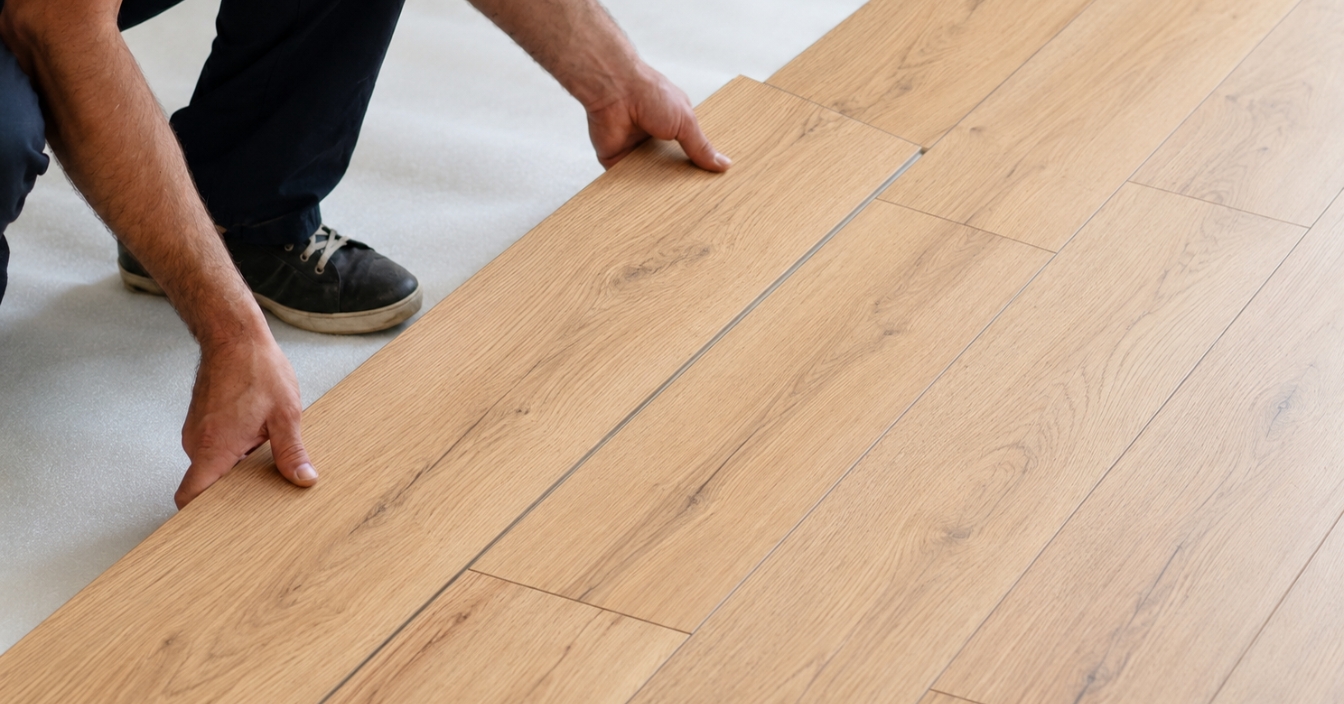
The quality of the joints between flooring planks is one of the most critical factors for lifespan. Although click systems seemingly all work in the same way, in reality, installation speed, long-term stability, and the possibility of repair vary significantly between them.
Angle-tap (classic non-5G system)
The oldest click system: the long side must be inserted at an angle into the previous row, then gently tapped in with a tapping block. It is a reliable, inexpensive technology, but time-consuming - for larger areas, it significantly slows down the laying of the flooring, as the already installed planks must be moved individually for each row.
Fold-down (5G)
The standard of the modern flooring industry. The long side is still locked at an angle, while the short side is simply clicked in from above. It is significantly faster than the angle-tap system and carries fewer risks of installation errors.
Drop-lock (Twin Click, Double Click)
The premium category: both sides of the plank can be clicked in from above - requiring neither angling nor tapping. It has higher production costs, making the end product more expensive, but it is the fastest and simplest installation method; furthermore, a single damaged plank can be easily replaced without having to lift half the room.
Selection criteria
Small rooms (10–20 m²): angle-tap is more than sufficient, higher quality is not strictly necessary.
Medium-sized areas (30–60 m²): fold-down is an ideal compromise.
Large areas (over 80 m²): the investment cost of the drop-lock system is offset by the saved installation time. For rental properties or frequently changing interiors, drop-lock is also the most practical choice.
Maintainability and replaceability
In a drop-lock system, a single damaged plank can be replaced without dismantling the surrounding planks - ideal if furniture is frequently rearranged or if a heavy object is dropped. With the angle-tap system, the same issue can only be resolved by dismantling half the row.
The cost of the click system is often not directly visible to the end user - but installation time, error tolerance, and long-term maintainability create sharp differences. For more demanding projects, selecting a higher-tier category is highly recommended.